
Irish Tourism: in pursuit of
dragons and tigers
Irish Tourism: in pursuit of
dragons and tigers
AUGUST 2026
AUGUST 2026
INTRODUCTION
Last month China Eastern Airlines commenced a three-times weekly service from Shanghai to Dublin. There is already a direct Beijing-Dublin route operated by Hainan Airlines as Irish tourism looks to grow business from this important new source market. With the Dublin Airport passenger cap set to be finally lifted, Ireland now has the real opportunity to strengthen connectivity to emerging markets that have to date been untapped. Irish tourism leaders are aware that there has been a growing dependence on North America for inbound visitation for a number of years and, although this needs to be deepened and defended, there is also a clear business need to market diversify. In that context China offers rich potential as does that other economic powerhouse, India.
In this bulletin the Irish Tourism Industry Confederation (ITIC) takes a closer look at the Chinese and Indian markets; their make-up, their propensity to travel, and the potential they offer Irish tourism in the years ahead.

DEMOGRAPHIC DYNAMICS
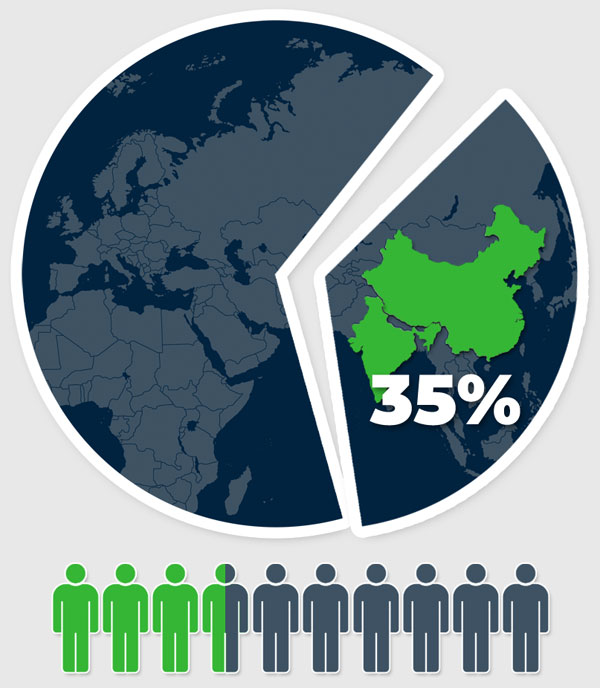
Out of every hundred people alive today 35 live in either China or India.
Last December the Irish Government published its national tourism policy statement entitled “A New Era for Irish Tourism” which featured a host of policy objectives. Among these was that marketing efforts should focus on high-growth regions and market segments. The policy statement rightly noted that growth can be achieved from mature source markets such as the US, Great Britian and Europe, but equally cited the need to develop direct air connectivity from emerging markets that offer the greatest growth potential, including those in Asia.
There are lots of prerequisites in order to see a steady flow of international visitor arrivals at a destination and we’ll take a look at those that are key, but clearly one of the building blocks is the size and composition of the population in a potential source market.
As highlighted in the opening sentence, China and India are home to a vast proportion of the world’s population, but there are some intriguing differences in both population trends and the age composition of each nation.
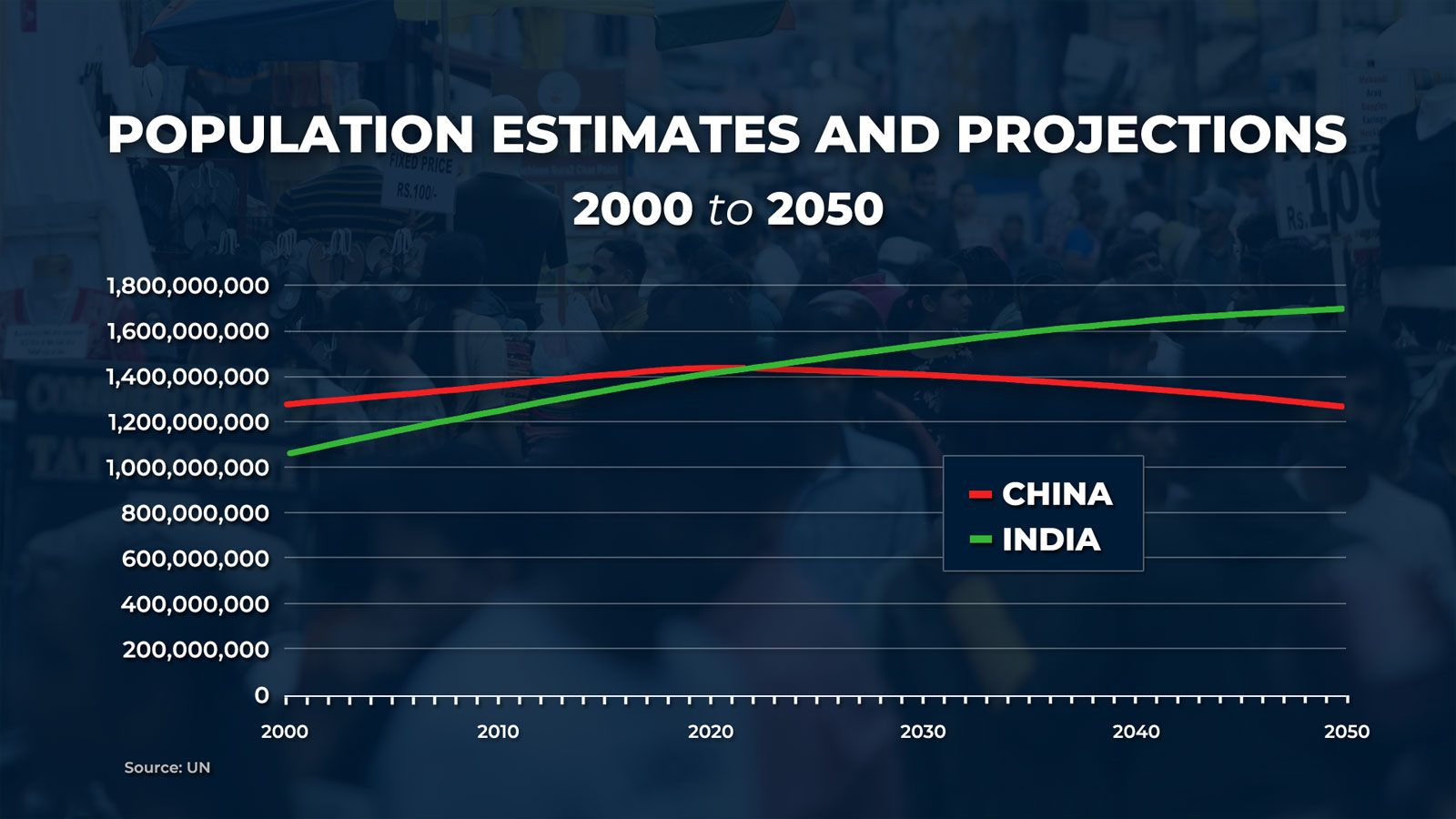
The chart below shows the estimated and projected population of each country from the start of the century through to 2050 and reveals that earlier this decade India usurped China as the world’s most populous country. Perhaps a more important insight is that China’s population is estimated to have peaked in 2021 and is set to decline by more than 150 million between now and 2050. By contrast, the population of India is projected to continue growing, with a potential 200 million more residents a quarter of a century from now.
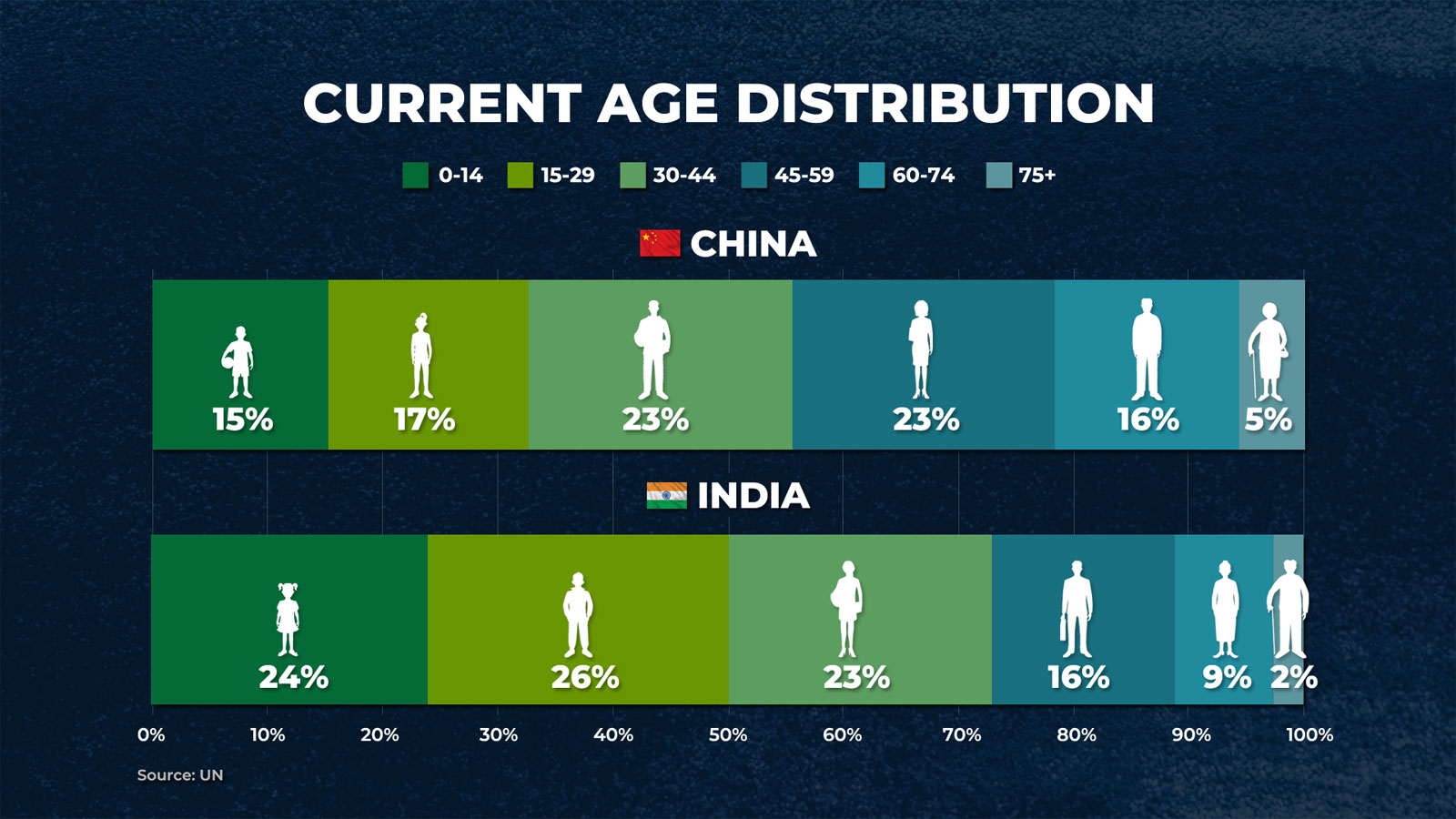
When we think about the challenges of an ageing population Japan often gets cited as a prime example, and rightly so, but what’s less well understood is that China too is facing a growing headache when it comes to the age structure of its population, not least because of its (by western standards) generous retirement arrangements. The already contrasting age distribution between China and India shown in the following chart is only set to grow in the years ahead, but even today whereas less than one-in-three of those in China is aged under 30 in India it is one-in-two.
ECONOMIC POWERHOUSES
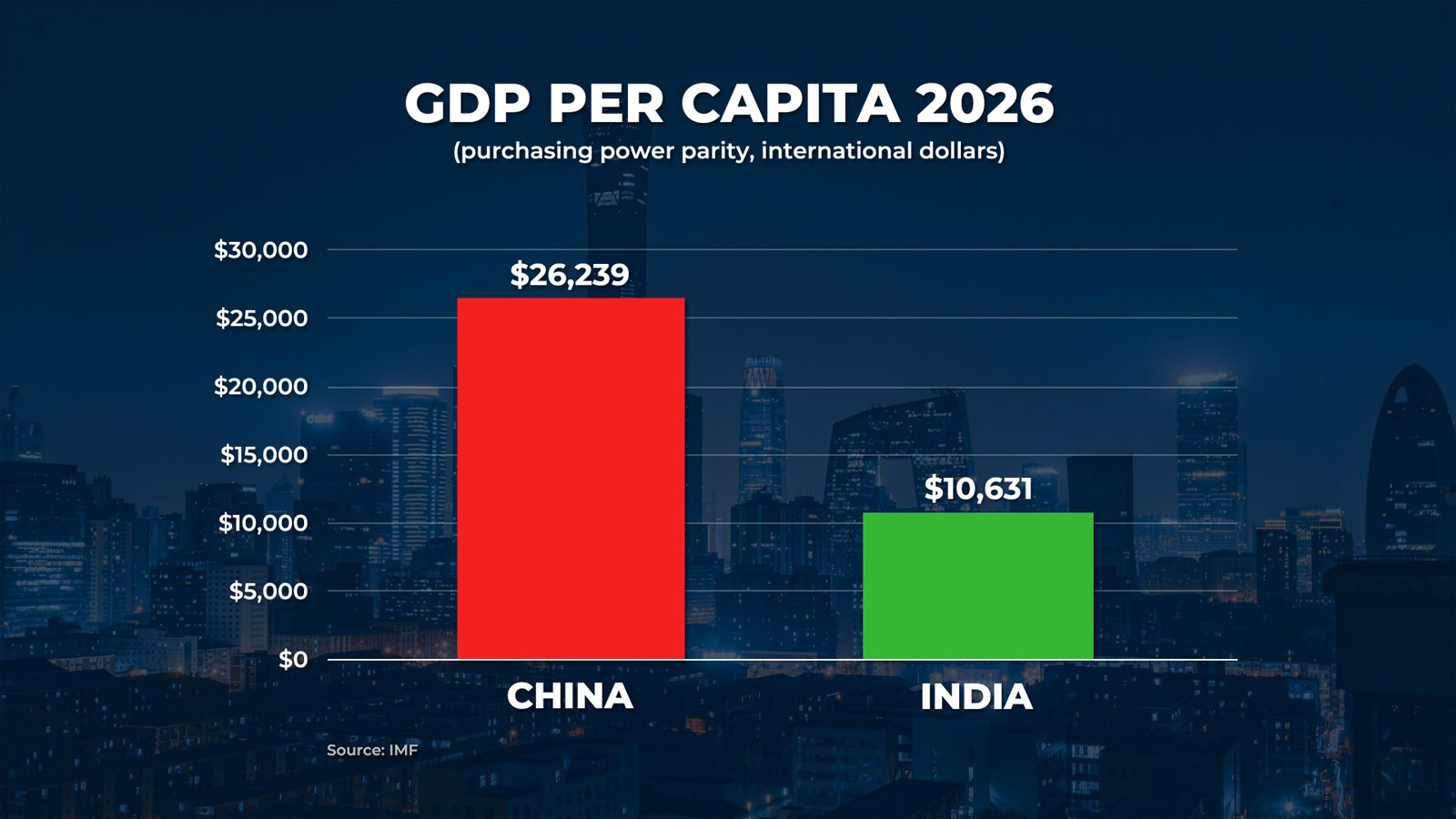
The extent to which a population has access to sufficient income to afford international travel is pivotal in determining its potential value as a source market to be tapped into. There’s no straightforward way of comparing incomes across nations, but thankfully boffins at the International Monetary Fund use a technique known as purchasing power parity to do this in an attempt to allow for the different cost of living from one country to another, and as a way of overcoming the added complication of countries having their own currency, the IMF use something called the international dollar.
We can observe from the next chart that as of this year GDP per capita on this measure is roughly two and a half times as high in China as it is in India, but it is probably helpful to provide a benchmark for a country closer to home, and the IMF estimate for per capita GDP in Ireland on this measure stands at $132,149, five times that of China and twelve times higher than in India.
Averages are an incredibly useful statistical tool but it is equally true to say they don’t tell us the whole story, and this is certainly the case when it comes to income per head in each of China and India. As well as there being droves of the population whose income is way too low to be able to contemplate taking an international holiday there are also plenty who enjoy an income way higher than the national average.
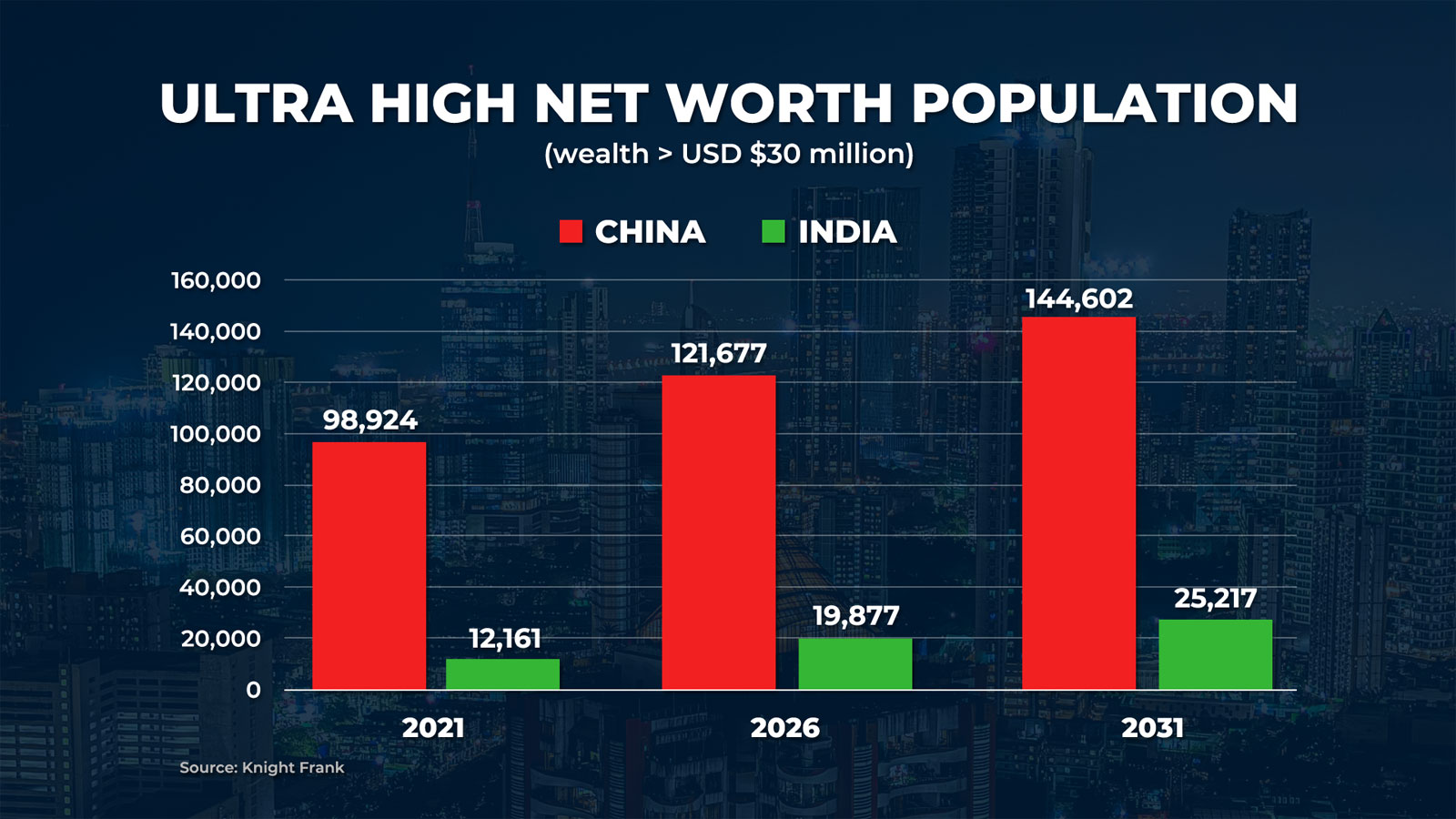
Knight Frank have published estimates and projections for what they term the Ultra High Net Worth Individual (UHNWI) population of countries around the world, and the chart shows their analysis for each of China and India in 2021, 2026 and what’s expected by 2031. To be an UHWNI you need to have net worth exceeding US$30 million. Evidently this is a segment that very definitely can afford the odd trip abroad. There has been rapid growth in those in both China and India who fall into this category, with the trajectory for the next five years one of continued expansion.
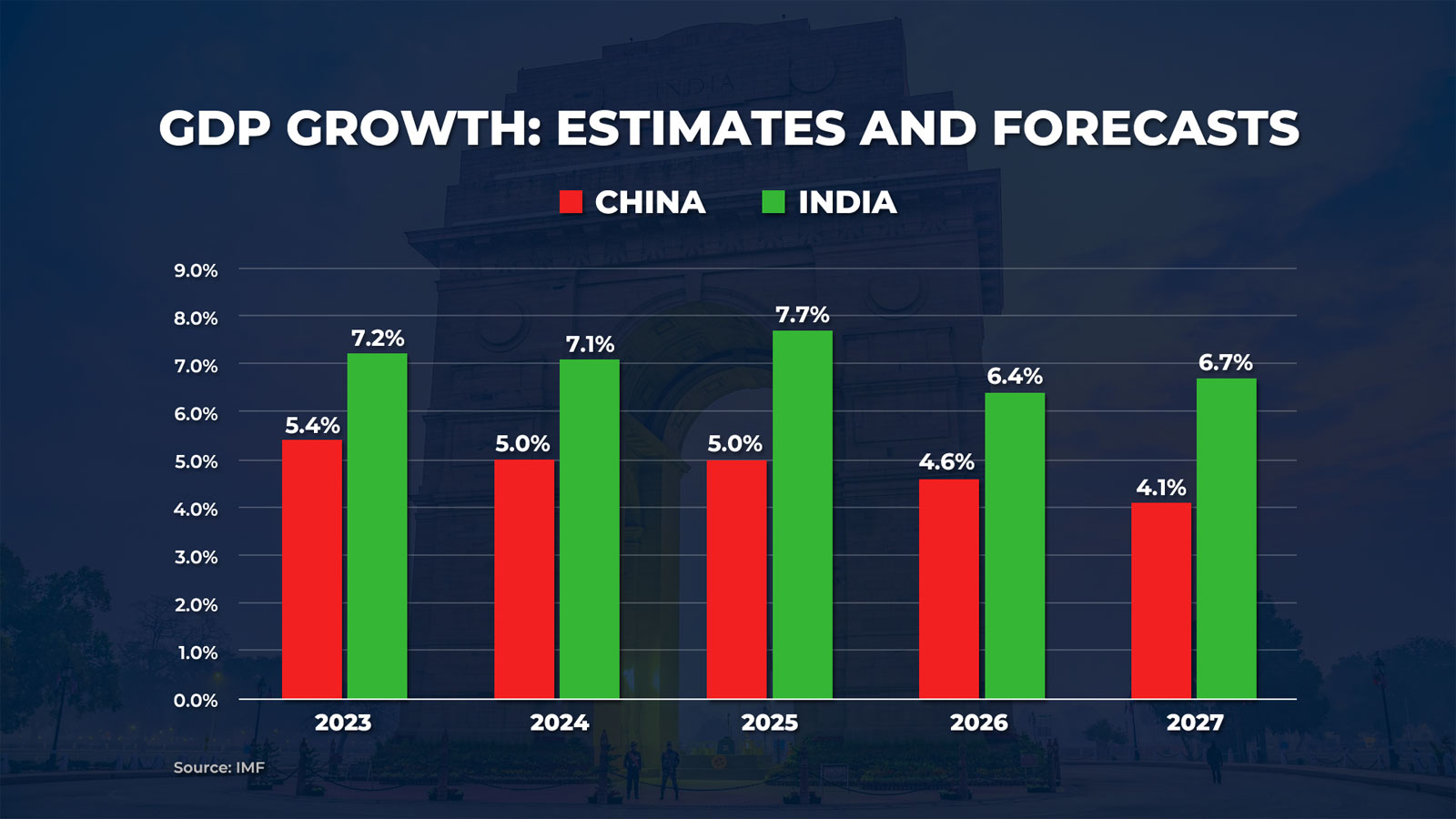
China and India have considerable global economic heft, with the IMF reckoning that China now accounts for 20% of global GDP, with India 8%. By European standards both the Chinese and Indian economies have been enjoying enviable rates of growth in recent years, but, as can be noted from the IMF data covering the recent past as well as projections for the near future, it is India that is seeing the swiftest rate of growth.
In addition to the demographic challenges referenced earlier China has something of a debt issue, particularly though not exclusively centred on the property market. Some estimates suggest that household debt is now equivalent to 60% of GDP.
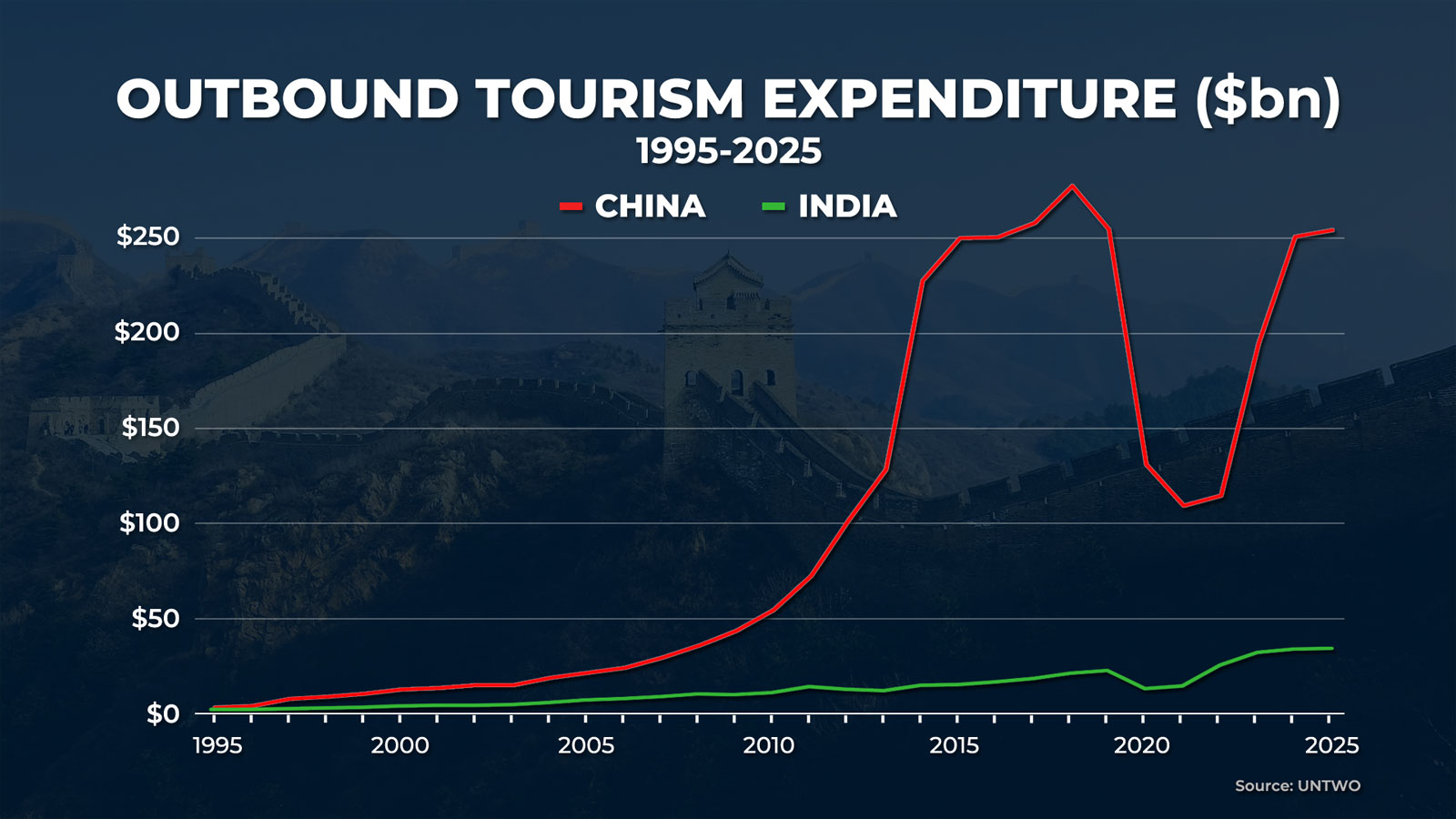
It’s high time we looked at data relating to tourism, and UNWTO stats allow us to explore trends in the total amount spent on outbound tourism (unadjusted for inflation) over the past thirty years. Here the figures are in billions of US dollars, and we can readily spot that outbound spending by those from China rocketed in the decade from 2008 to 2018, making it the world’s most valuable outbound source market. The amount spent on outbound travel certainly rebounded post pandemic, but what’s notable is that it was still well below the 2018 record last year, even though the figures are in nominal terms. The sluggish year-on-year growth in 2025 tells us that growth is perhaps now on a more modest trajectory than had been the case a decade or so ago. The line showing outbound spend from India is much more modest, but at $36 billion last year was an all time high and it is now comfortably within the world’s ten most valuable outbound markets.
TRAVEL PATTERNS
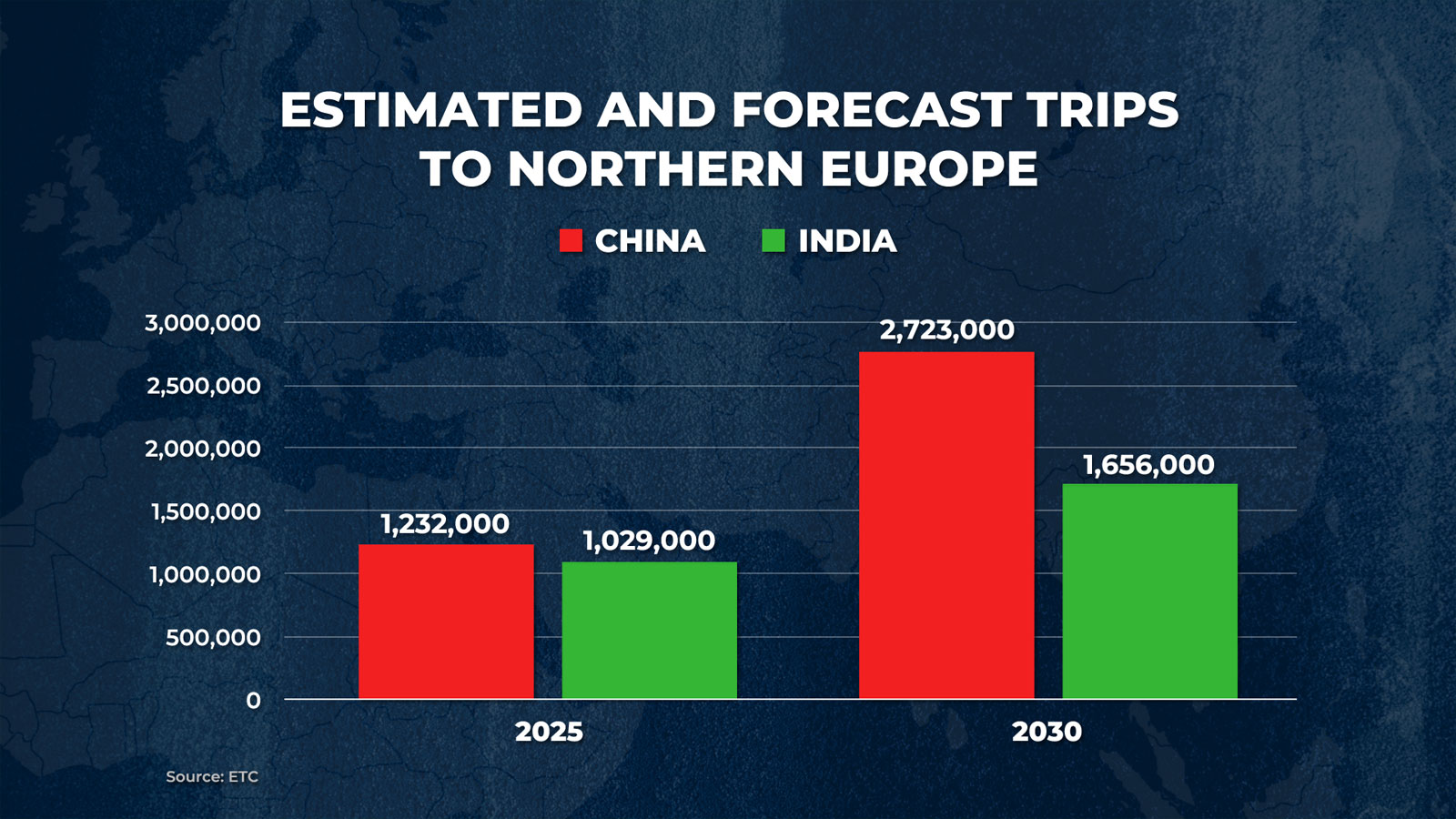
The European Travel Commission publish estimates and forecasts produced by Tourism Economics on the number of trips from each of these markets that are to Europe, and different regions within Europe, with the chart showing the tally for 2025 and forecast for 2030 relating to a cluster of countries classified as being in Northern Europe (Denmark, Finland, Iceland, Ireland, Norway, Sweden and the UK).
China is estimated to have generated slightly more trips than India last year, and the forecast for the next five years is somewhat more bullish for the former than for the latter, but we need to keep in mind that part of the explanation for this is the much slower recovery in outbound travel from China than has been the case for India in the past two or three years, meaning some of the forecast China growth represents “catch-up”.
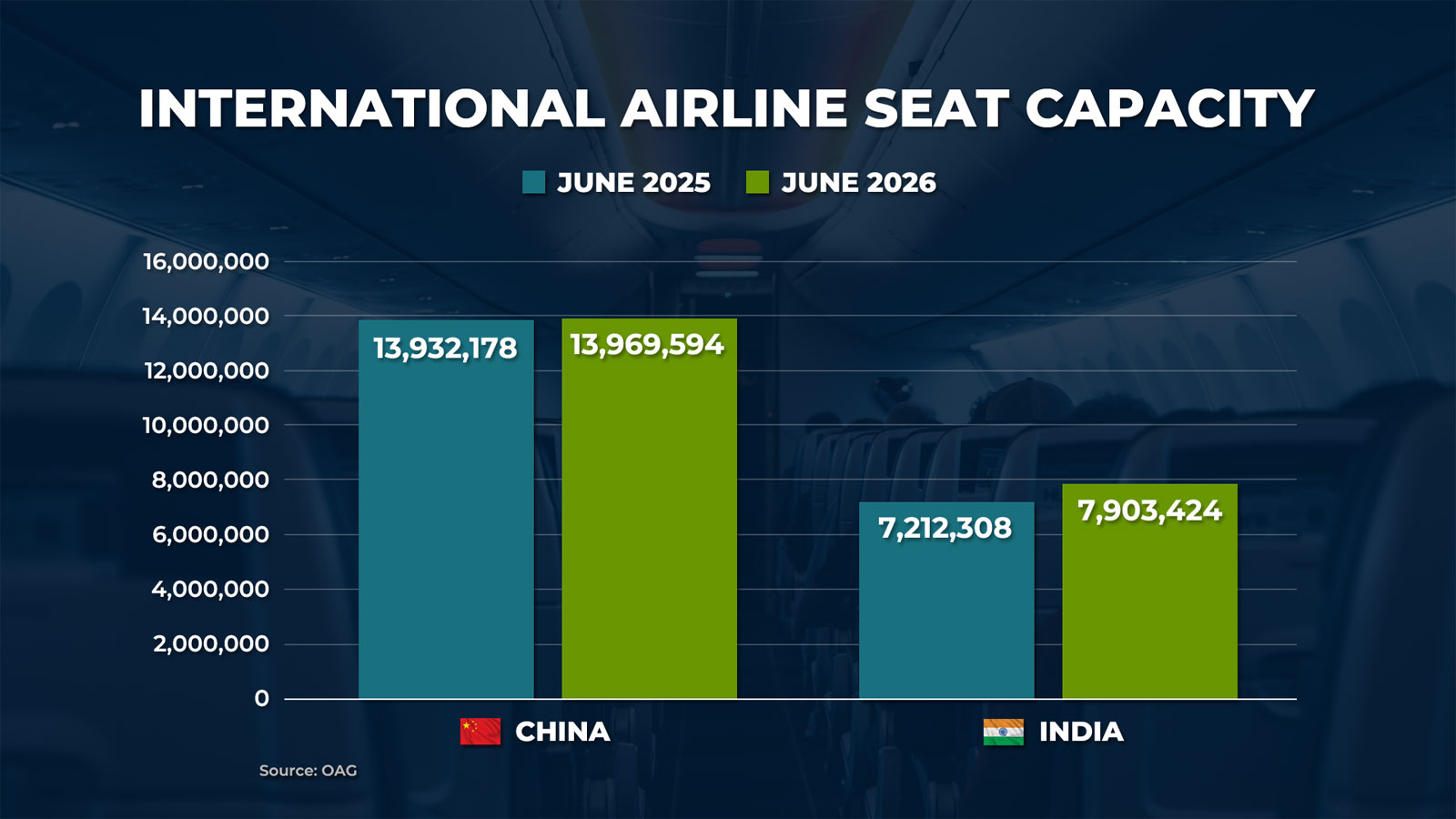
If folk have enough money to travel internationally for leisure another crucial element of determining which places they travel to will be the ease of getting to them. Data from OAG allows us to look at total international airline seat capacity from each of China in India in June of last year and this year, with the chart indicating that India lags China, but has seen faster growth in capacity during the past twelve months.
The five territories with the greatest seat capacity out of China in June were; South Korea, Hong Kong, Japan, Thailand and Singapore. The first European country to feature in the league table is the UK which with 137,096 seats in June held 13th spot, one place ahead of the USA (worthy of note because seat capacity between China and the USA is 71% lower now than back in 2019).
The top five territories for international seat capacity from India in June were the UAE, Thailand, Singapore Saudi Arabia and the UK (with 213,026 seats). Germany was the only other European country making it into the top ten from India in June (94,600 seats).
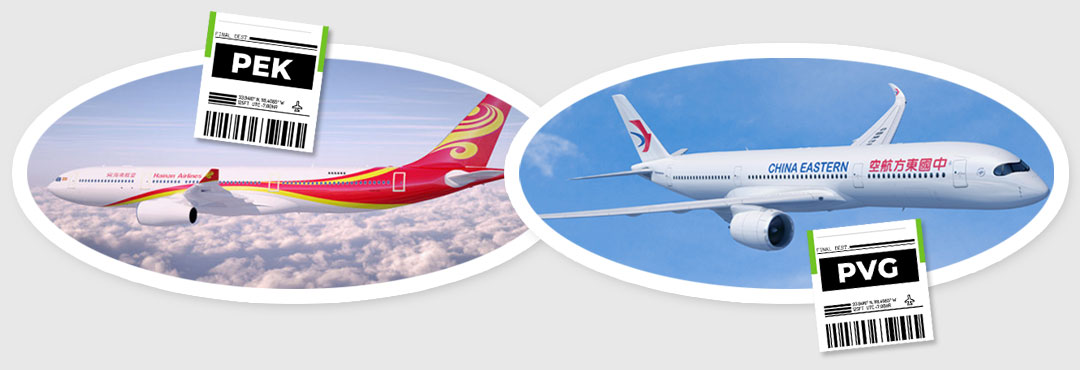
Ireland currently has a daily flight from Beijing with Hainan Airlines, and the new thrice-weekly service with China Eastern from Shanghai. However, there are no direct flights to Ireland from India.
Being able to fly direct rather than via somewhere else has huge potential to unlock demand. Not only does this reduce the journey time but it can often lower the bureaucratic burden (and cost) of the trip. For example, visitors to Ireland from China or India transiting via the UK will have to figure out if they need/want to apply for a British Irish Visa Scheme visa or make the necessary transit visa arrangements with UK authorities as well as applying for a visa to visit the Republic of Ireland. Similarly, if the visitor is transiting elsewhere in Europe they would be faced with two sets of border requirements (unless in direct airside transit at certain European hub airports).
While most visitors from China to Europe will likely fly direct to an airport somewhere in Europe, traditionally a great deal of demand from India has transited in one of the Middle East hubs, a fact that will have hindered growth in travel from this market during 2026 due to the US-Israeli war with Iran.
TRAVEL MOTIVATIONS
So, we have looked at the need for there to be a population, for that population to have sufficient money to travel, and the importance of connectivity, but there’s another key ingredient too, namely motivation. People travel for a plethora of reasons, often a complex ecosystem of push and pull factors will shape where someone chooses to go for a holiday.
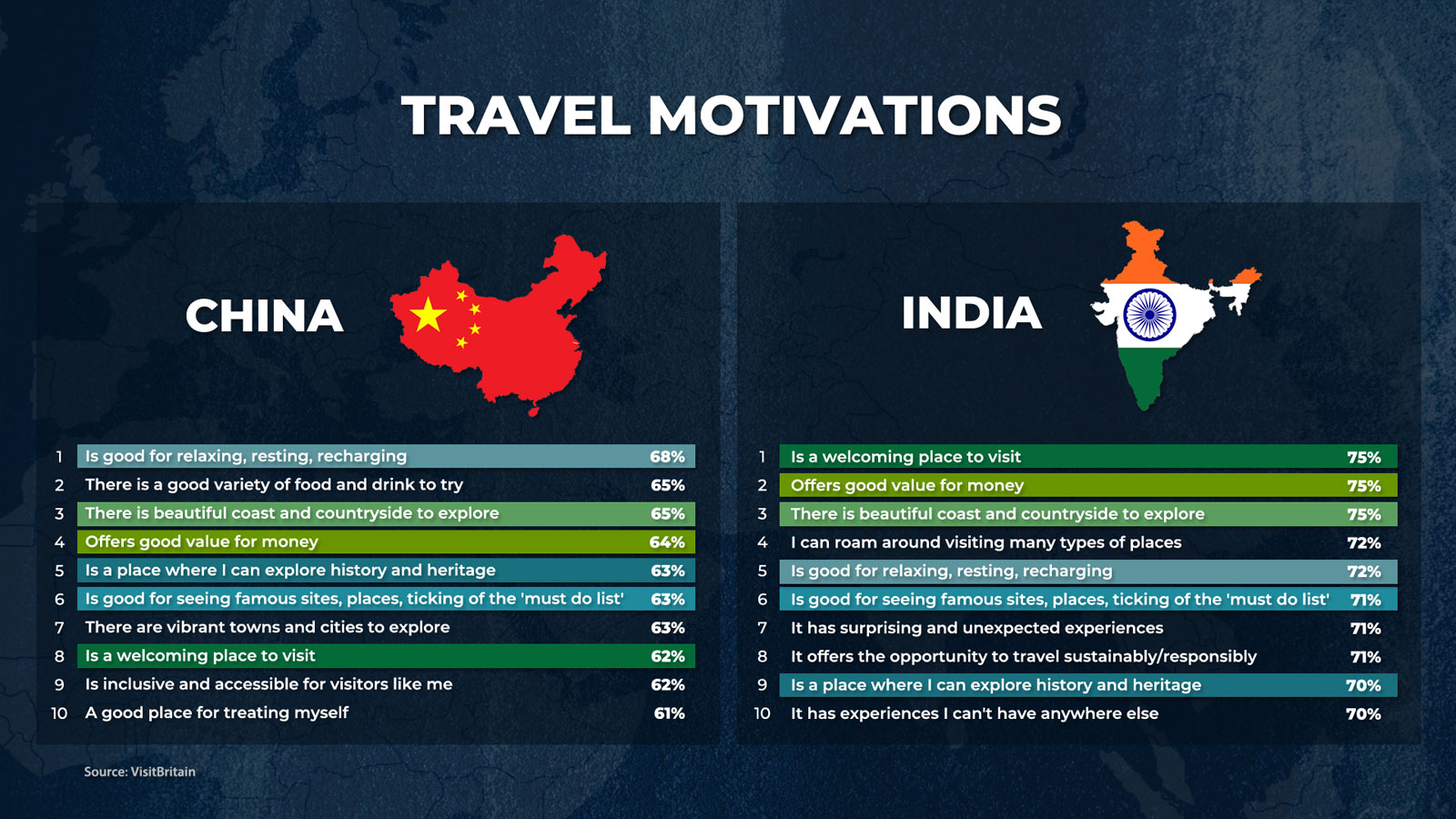
To help shine a light on the sorts of things that motivate those in China and India to select a destination we can mine research undertaken by VisitBritain, as one of the questions explored the extent to which various factors were considered “Extremely important” when selecting a destination.
The table below presents the ten statements seeing the highest proportion of respondents saying that this was “extremely important”. It’s wise not to take the actual percentages too seriously as the ways in which people respond to surveys vary from one country and culture to another, but it is nonetheless helpful in telling us what sorts of things play a role in how those in China and India go about deciding on a holiday destination.
The shading highlights were a statement features in the top ten for both markets, and we can see that six individual statements are common to both lists, though often with their place among the top ten a little different.
The insight to take away is that how a destination is expected to make the respondent “feel” is important, evident from the extent to which people highlighted “Is good for relaxing, resting, recharging” and “Is a welcoming place to visit”. These emotional benefits that the destination is perceived as offering work alongside the “features” that are hoped for, namely “There is beautiful coast and countryside to explore” and “Is a place where I can explore history and heritage”. Plus, a successful destination has to meet some basic functional needs, primary among which is that it is perceived to “Offer good value for money”.
The more Ireland can do to demonstrate it ticks all the boxes, whether that’s functional matters, a varied product offering, or delivering emotional benefits, the greater the likelihood it will attract visitors from these markets.
Even if relaxing is a motivation there’s every chance that those holidaying somewhere will want to do stuff during their trip, and we can again delve into the VisitBritain research, this time focussing on the proportion of respondents who said that they have a high interest in undertaking various activities when they are on a holiday or short-break.
Those taking part in the survey were asked about lots of activities, but the table below conveys the ten that got the most positive response, with shading again used to highlight were an activity made it into both top tens.
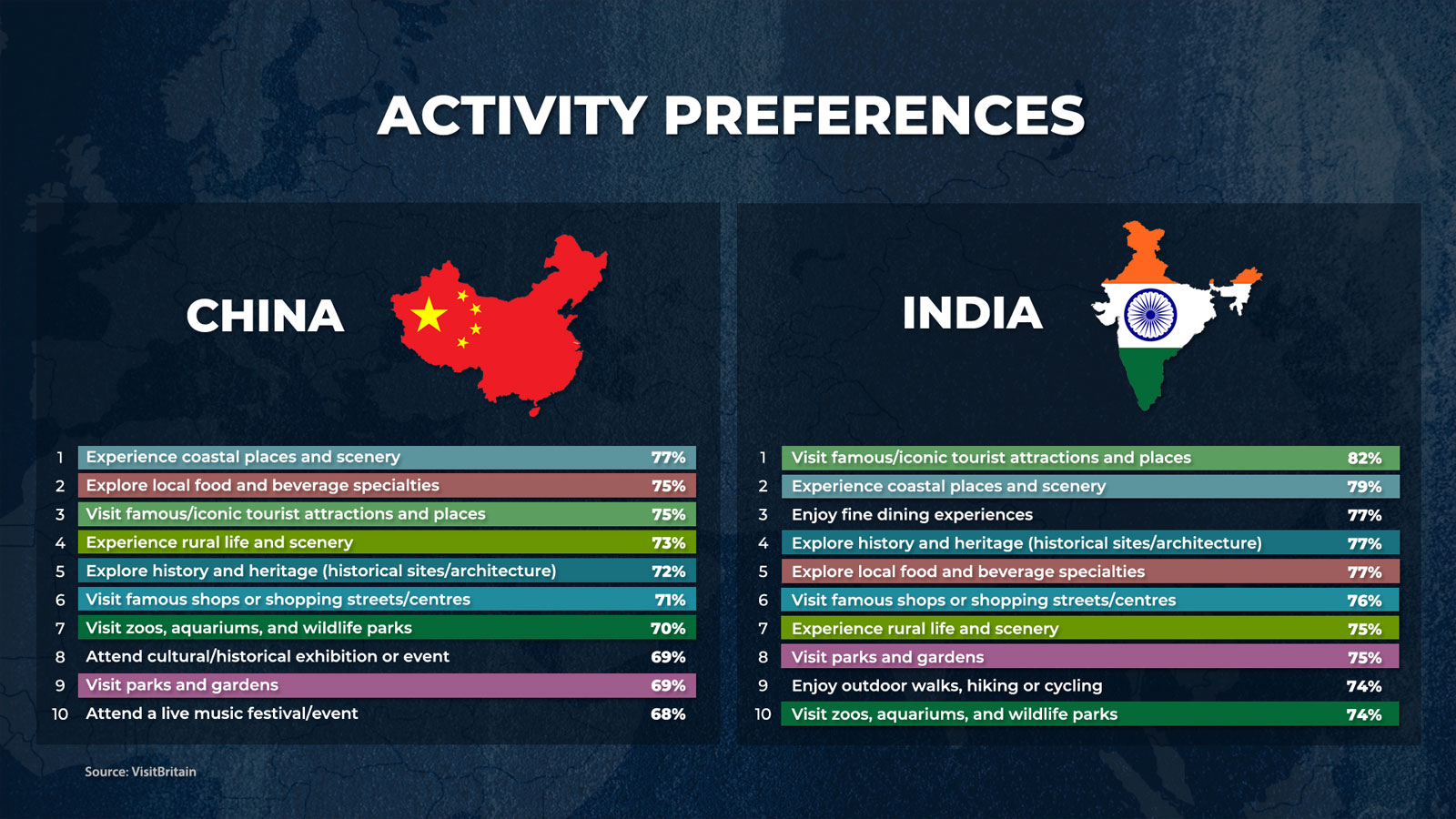
The two top threes share a couple of activities; “Experience coastal places and scenery” and “Visit famous/iconic tourist attractions and places”. “Explore history and heritage (historical sites, architecture)” squeezes into the top five for both those in China and India while other rural or nature based activities put in a number of appearances, as do food or dining-related activities.
Ireland has a strong hand to play across many of these activities, especially the opportunity to “Experience rural life and scenery” as well as those relating to heritage and culture. Furthermore, these are the sorts of activities that can help attract visitors to explore beyond Dublin, meeting another of the objectives in the government’s policy statement.
CONCLUDING COMMENTS
Despite accounting for 35% of the world’s population, China and India today account for just 15% of the amount spent by international tourists. The fact that both economies are growing at a far faster rate than is true for those in Europe or North America tells us that with every passing year the two will see growing numbers of citizens with the financial wherewithal to travel abroad for leisure. That means the share of global international tourism expenditure they represent will over time pull closer to their share of the global population.
Most visitors to Ireland live within a two or three hours flying time, or reside in North America, but with ambitious growth targets for inbound tourism and a distinct need to ensure market diversification, pursuing dragons and tigers can serve Irish tourism businesses well in the years ahead. Of course market penetration will need adequate resources and let’s hope Budget 2027 delivers appropriate tourism marketing funds.